Friday, July 16, 2021

JESUS PAID IT ALL

(Part of a monthly series on inspiring hymn stories.) Elvina Mable Hall was 45 years old and a bit bored as she sat in the choir loft one spring Sunday in 1865. According to one researcher, the pastor prayed much too long. According to another, her mind wandered during his sermon. Whatever it was that Sunday at the Monument Street Methodist Church in Baltimore, Elvina picked up the hymnal and in its flyleaf scribbled a poem that came to her. The four verses began:

I hear my Savior say/Thy strength indeed is small,

Child of weakness, watch and pray,/find in me thine all in all.

When the service ended, and everyone else had left the church, she came up to the pastor and apologetically admitted her mind had wandered. But here was a poem she had written. Would he like to see it?

The pastor turned out to be the matchmaker of lyrics and hymn tune. In his files was a tune written by the church's choir director, a man named John Grape. In “real life” Grape was a coal merchant. But he dabbled in music, as he liked to say. Ira Sankey (known as a song leader for D.L. Moody), in a later book about hymns, reported Grape as saying:

Our church was undergoing some alterations and the cabinet organ was placed in my care. Thus afforded a pleasure not before enjoyed, I delighted myself in playing over our Sunday school hymns. I was determined to give tangible shape to a theme that had been running in my mind for some time—to write...an answer to Mr. Bradbury's beautiful piece, “Jesus Paid it All.” I made it a matter of prayer and study, and gave to the public the music, now known as the tune to “All to Christ I owe.” It was pronounced by poor by my choir and my friends, but my dear wife persistently declared it was a good piece of music and would live. Time has proven the correctness of her judgment.

Remarkably, Elvina's poem and Grape's earlier tune and chorus lyrics were a good fit. The hymn was published three years later, in 1868, in a collection titled “Sabbath Chords.”

How fitting that this marriage of words and tune could come about through an “introduction in church.” It's a meaningful hymn for any time we need the reminder of the cost of our salvation.


For listening or singing along;

This gentle solo version has a country-music-style accompaniment (skip short ad to get to video):

https://www.youtube.com/watch?v=y9DUKhFhD74

This contemporary rendition, with a more driven tempo at the end, has splendid photography to support the hymn's words:

https://www.bing.com/videos/search?q=%22jESUS+PAID+IT+ALL%22&view=detail&mid=46A71D1306A94E4AAAA446A71D1306A94E4AAAA4&FORM=VIRE0&ru=%2fsearch%3fq%3d%2522jESUS%2bPAID%2bIT%2bALL%2522%26form%3dANSPH1%26refig%3d8a2204490f2a40a9b334acba6db1d33b%26pc%3dU531%26sp%3d-1%26pq%3d%2522jesus%2bpaid%2bit%2ball%2522%26sc%3d8-19%26qs%3dn%26sk%3d%26cvid%3d8a2204490f2a40a9b334acba6db1d33b


Friday, July 9, 2021

LEGACY

She died at 80 when I was eleven years old, yet despite our limited contact, I remember with gratitude my great grandmother's spiritual legacy. Born in Norway, as a child she immigrated to America with her parents. But her mother died soon after coming to America. Her father remarried, then he died. His widow remarried, meaning my great grandmother was raised by double stepparents. More sorrow would come. She was married at 19 to another of Norwegian heritage, but he died at 33 after they had four daughters together—my grandmother being the oldest. She remarried and had four more children. Her first name was Rachel (born “Ragnild” in Norway) but we always knew her as “Great Grandma Neely,” the surname of her second husband.

One of my mother's six brothers was a genealogy buff, and before his death produced a 579-page family history—two inches thick—of photos and charts. That's where I found Great Grandma Neely's wedding photo and put together the pieces of her two marriages and perseverance in times when medical care was inadequate and people died young. When she died at 80, that was old.

She spent her “very senior” years visiting her special relatives. That included my mother, who would have been her first grandchild. My mother was the oldest of nine born to great grandma's firstborn and an impoverished Norwegian farmer. When my mother graduated high school, she had no future except to help care for her parents' large, needy family. Great Grandma wanted better for her. By now in her second marriage, and more financially able, she sent money for my mother to travel from eastern Montana to the Longview-Kelso area to live with her. She said she'd make sure my mother got an education to prepare for a life work. I'm not sure what courses my mother took that year at the local junior college, but in attending church she found her true vocation as wife to a young man from Missoula, Mont.

Back to those “Great Grandma” visits. I think, as the youngest, that I gave up my twin bed for Grandma Neely and slept on the couch. Days, she'd sit in my dad's favorite rocker, crochet hook busy when she wasn't reading her black leather Bible or snoozing. For years in our shower we had a crocheted “soap bag” she made. It allowed slivers of soap to be saved and used until they'd entirely melted away. But that wasn't what I remember most.

I was about fifth grade, when little “autograph books” were the rage. About 4x6”, they had colored pages on which your friends were to write their names and silly ditties, like “When you get old and think you're sweet, take off your shoes and smell your feet.” When I asked her to sign my autograph book, she graciously took it with a smile, then penned something I never anticipated:

I have no greater joy than to know that my children walk in truth. --3 John 4 –Great Grandma Neely

I wish I still had that book, but in the purging of life and moves, I don't. But I do have another memento of her faith life: the tiny black pocket New Testament she gave me. I keep it by my recliner with other Bible materials, sometimes just to read favorite passages in the King James cadences. And when I do, I remember this bilingual, godly great grandmother, no stranger to sorrow and loss, who kept the embers of faith fresh through prayer and Bible study.

I was told that in her last days, dying from strokes at age 80, she struggled with words to tell a granddaughter caring for her that angels were just over the river, ready for her. And she was ready for them. As I have grown older, I wonder about the legacy I will have left when I die. Yes, I've had the privilege of writing books and articles, and of speaking to various groups. I raised two children to responsible adulthood (with the help of their remarkable dad). But what will really count, in the end, is whether I have left the legacy of children who “walk in truth.” I pray that will be so.

Friday, July 2, 2021

CATERPILLAR EYES

We have an ongoing private joke in our family about people who are obsessed with their appearance. Decades ago, for reasons we've forgotten, a visitor to our home went into great detail about the products she used for her hair. “My hair is very important to me,” she said, flipping her long locks. Since then, whenever my husband or I need to chide each other about vanity, we borrow that phrase, “My (fill in the blank) is very important to me.”

That inside-the-family joke came back to me recently when I was browsing the newspaper coupon inserts for products we might use. So many for hair color and makeup! But the one for an eye cosmetic made me think of another inside-the-family joke, about overdone eye makeup and false eyelashes which we call “caterpillar eyes.” You get the picture, I presume, with multiple black insect feet. This ad was for not one, but TWO products for “gorgeous eye looks.” One product was called the “lash blast amplify primer” and the other (to follow #1) the usual black sweep. Oh, “vegan” in origin, in case that concerns you.

A few days later the newspaper's entertainment insert featured the latest movie about a weird woman obsessed with Dalmatian dogs. You know the one: half of her hair black, the other white, and what we call (in the same jesting way) raccoon eyes. Yes, “Cruella.” Believe it or not, she's not an original. Probably an ancient, idol-worshiping queen named Jezebel was. Her story about challenging her prophets of Baal against Elijah's God took up quite a bit of space in 1 Kings 16-18. When her pagan priests “lost” the battle of the gods, she threatened to kill Elijah.

The rest of the story comes in 2 Kings 9 , fourteen years after her husband Ahab's death in battle. She wielded considerable influence over her son Jehoram, living in the palace. When war roared at the city's gates, she piled up her hair in the queenly fashion and painted her eyes with antimony, a metal we now know to be toxic but was prized for accenting one's eyes. The warrior who took the city, Jehu, wasn't impressed by Mrs. Raccoon Eyes, and she was killed. It gets gory from there, but the story is in 2 Kings 9:30-37.

As a product of the Depression and impoverished farm life, my mother didn't grow up with a lot of cosmetics savvy. Her motto would have been “A little powder and a little paint make a pretty little girl look like what she ain't.” She didn't have a chest of “war paint” in the bathroom drawers. She stretched out her tiny sample of lipstick from the door-to-door cosmetics salesperson as long as she could. Thus I grew up without a lot of makeup savvy and still am a minimalist. Maybe that's why I find double-duty eye makeup rather amusing. I still remember the day my teen daughter convinced me to have a “makeover” at a local cosmetics store. Oh, the array of products. I bought just a lipstick. As we got outside into the sunlight, my daughter turned to “painted”-me and said, “Mom, you look like a clown!”

I'm not against makeup and some of us need a lot of help! But I think the balance was expressed by a lady who was the opposite of Jezebel (and Cruella). The Bible calls her Mrs. Noble. She had a work ethic that went from sunrise to sundown. She raised kids who loved her. She didn't fret about the future and spoke with wisdom. Her husband said of her: “Charm is deceptive and beauty is fleeting; but a woman who fears the Lord is to be praised” (Proverbs 31:30).

Yes, our cultures are thousands of years apart, but I think she would have put this whole cosmetics industry in perspective. Somehow, I don't see her viewing her world through caterpillar eyes.

(In thinking about cosmetics on Bible times, remember they didn't have handy bathing facilities to stay clean and, well, smell good. Thus perfumers and makers of cosmetics had essential businesses of their times. But there's a line where societal norms pass over to obsession. I think that's why the prophets mentioned overdone makeup in negative ways as symbols of national deterioration. Two more references on that: Jeremiah 4:30 and Ezekiel 23:40. None of the prophets wrote best-sellers, but they said what God felt needed to be said.)

Friday, June 25, 2021

DON'T GO THERE

What do you do when your life is rocked through no fault of your own? I asked that after my family was hit by a drinking driver. Hundreds of miles from home, we had a totaled car and personal injuries. But we survived. The cuts, sprains, and broken teeth got repaired. The emotional and spiritual wounds, however, took time. That's why I was grateful for the principles expressed in a book by another drunk-driver victim, Whitworth College professor Gerald Sittser. One night in 1991, while Sittser drove his family home from an event, they were hit by a drunk driver  who veered into their lane at high speed. That man died—along with Sittser's wife, mother, and one of his four children.

Left a working single parent of three with a huge hole in his heart, Sittser somehow had to move forward. With God's help, he did. His book, A Grace Disguised: How the Soul Grows Through Loss (1995) wrestled with the why's of innocent suffering. That was followed in 2000 by The Will of God as a Way of Life (both published by Zondervan). Recently, re-reading that second book, I was struck by the succinct but powerful truth that we grow either better or bitter through hardship. And bitterness is a wretched way to live. Sittser wrote:

There is nothing we can do to change our past. It is as hard as granite, as immovable as a mountain. What is done is done. Regret, bitterness, revenge—none of these can alter what has already happened. No matter how many times we say “if only,” regret cannot alter our past. No matter how bitterly we brood, blame, and accuse, the wrong done to us will remain as it is. No matter how often we rehearse a plot of revenge, we will never be able to reverse the course of events that created our pain in the first place. Regret, bitterness, and revenge will only ruin us. We will become prisoners in our own dark souls, suffocated by our own brooding thoughts. (p. 159)

So what's the solution when bitterness is eating you up from the inside out? Sittser's counsel:

  1. Confess your bitterness, failures and responsibilities to God.

  2. Be willing to forgive. “The one who suffers the most from bitterness,” Sittser said, “is the one who is bitter. What infection does to the human body, bitterness does to the soul. It consumes. The antibiotic used to treat the disease of bitterness is forgiveness” (p. 163).

Research on mental health, he observed, has affirmed that “forgiveness mitigates depression and anxiety, increases self-esteem, and improves physical health and emotional well-being. It releases people from living in bondage and allows them to live in freedom. Forgiveness heals the soul” (p. 164).

In my case, I made something “good” of something “bad” by speaking out for sobriety for a decade at “education seminars” required of convicted drunk drivers. Sittser brought good out of his nightmare by searching scriptures and encouraging others in their struggles through his thoughtful, articulate writing and speaking.

But we don't need to speak and write to forge a path of healing through pain. This verse has been an anchor for me in my pain: “I will repay you for the years the locusts have eaten” (Joel 2:25). The prophet was telling his nation (Judah) not to give up on God, despite a natural disaster (locusts that stripped the land) and impending takeover by an enemy nation.

Bitterness is a dead-end road. If life has brought us pain and sorrow, we can dwell on that and grow more bitter. Or we can shovel up those dead locusts that stripped our lives bare, and—with God's help--plow fresh ground for crops of hope and healthy relationships.

Friday, June 18, 2021

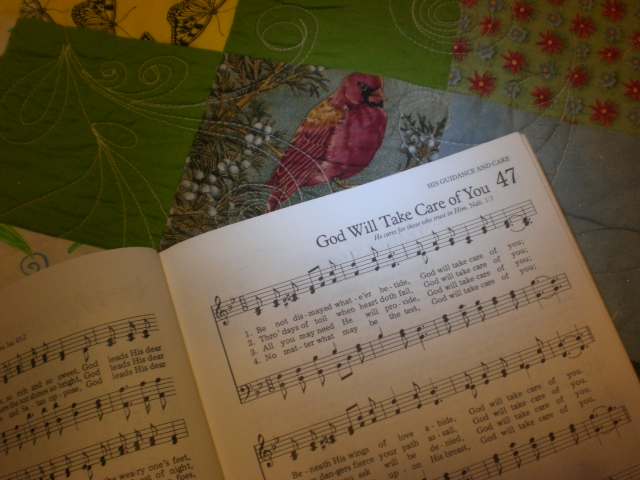
GOD WILL TAKE CARE...

Part of a monthly series on inspiring hymns.

Can you name the author of the hymn titled “The Blood Will Never Lose Its Power”? If you said “Andre Crouch,” you're partially correct, for that phrase is in the Gospel song that the well-known musician of our times (1942-2015) composed when only a teenager. But it's possible he was influenced by a song written several generations earlier, that also had that title. Its author was a Canadian-American pastor's wife, Civilla Durfee Martin (1866-1948)--her unusual name meaning “civil, respectful.” She was married to Walter Martin, who after his Harvard education became a Baptist minister but later switched to the Disciples of Christ. Civilla was the lyricist, and he the tune-writer of their hymn-writing team as they lived and served churches and colleges and did evangelistic work in New York, North Carolina, and Georgia.

Another hymn for which she is better-known was “God Will Take Care of You,” and which was prompted by a comment by their nine-year-old son. One Sunday Walter had a preaching assignment at some distance from their home. However, Civilla was very sick that day and Walter wondered if he should cancel the preaching trip. While they discussed their options, their little nine-year-old son piped up, “Father, don't you think that if God wants you to preach today, He will take care of Mother while you are away?” Walter decided to go ahead and preach. When he finally got home, Civilla was feeling much better. Plus, while he was away, she'd written a new hymn based on their son's remark. Within an hour, Walter had written a melody for it. Before the night ended, some teachers at the school where he taught came by and sang it. Later that week, it was sung at a school assembly. Its next stop was a hymnbook—the 1905 “Songs of Redemption.”

One story told of its impact concerned entrepreneur J.C. Penney, who had descended from a long line of Baptist preachers. When the Great Depression hit in 1929, Penney's businesses soured. His health suffered greatly, even to needing hospitalization. Filled with despair, one morning he heard singing from the hospital chapel. The lyrics, “Be not dismayed whate'er betide/God will take care of you.” He went to the chapel service and his worries were transformed to hope as he realized how much God cared for him. Eventually, the store bearing his name became an American retail giant.

Another song, written about 1903, was inspired by the faith of a bedridden saint in Elmira, New York, whom Civilla visited. While reading and singing to this person, Civilla asked if she sometimes got discouraged. The woman responded by referring to the Bible passage about God's care for even the sparrows. Soon after, Civilla found some paper and a pencil and quickly composed the lyrics. Well-known Gospel song composer Charles Gabriel set it to music. Half a century later, in 1958, Gospel singer Mahalia Jackson would make “His Eye Is on the Sparrow” her signature song. Ethel Walters also famously sang it in the 1952 film “The Member of the Wedding” and at Billy Graham Crusades.

Other lyrics by Mrs. Martin, better known in earlier times, included “The Breath of the Spirit,” “The Old-Fashioned Way,” and “Wonderful Love.” But it's her songs about the power of the Blood and God's watch-care that have endured for more than a century after they were penned.

Sing along with this You-Tube with beautiful scenery:

God Will Take Care of You - Hymn - Bing video


Friday, June 11, 2021

GIVING THE BEST

The "prop" for this old graduation cap is full of air--
hopefully not the condition of its former wearer (me)!
Graduation time! Who didn't know of someone who graduated high school or college this year? With the moving of the tassel comes great dreams and great aspirations. Yet often, the high of “graduation” is followed by the low of reality. Relationships change. Jobs are scarce. They're supposed to move on—but to what?

Imagine the dashed hopes of youth after America's Civil War. Casualties—death and disability-- devastated families. Years of war left the country in financial shambles. The country's youth wondered what, really, was their future? Then in 1881, out of the ashes and disillusionment of that conflict, a youth evangelical group was birthed in Portland, Maine. Founders described its purpose as “to promote an earnest Christian life among its members, to increase their mutual acquaintanceship, and to make them more useful in the service of God.” Its membership soon spread to the British empire and beyond. By 1906 there were 67,000 youth-led Christian Endeavor societies, with more than four million members, across the world.

This was no local high school Bible study/fun night. Its membership pledge reflected the founders' desire that youth have a useful place in the church:

Trusting in the Lord Jesus Christ for strength, I promise Him that I will strive to do whatever He would like to have me do; that I will make it the rule of my life to pray and to read the Bible every day, and to support the work and worship of my own church in every way possible; and that just so far as I know how, throughout my whole life, I will endeavor to lead a Christian life.

As an active member I promise to be true to all my duties, to be present at and to take some part, aside from singing, in every Christian Endeavor meeting, unless hindered by some reason which I can conscientiously give to my Lord and Master, Jesus Christ. If obliged to be absent from the monthly consecration meeting of the society, I will, if possible, send at least a verse of Scripture to be read in response to my name at the roll call.”

Leaders of the organization started publishing materials, including a hymnal for meetings, edited by Rev. Howard Grose, a Baptist minister who wore many hats during his life: university president, history professor, and editor of Christian Endeavor Journal for 23 years. He wrote the lyrics for a Christian Endeavor hymn. It was matched to a tune composed by a prolific British ballad writer, Charlotte Barnard. The hymn's lyrics follow the organization's encouragement to give God the best of your life, not the scraps:

Give of your best to the Master; give of the strength of your youth.

Throw your soul's fresh, glowing ardor into the battle for truth.

Jesus has set the example, dauntless was He, young and brave.

Give Him your loyal devotion; Give Him the best that you have.

The three verses and chorus to this hymn can be found here:

Give of Your Best to the Master > Lyrics | Howard B. Grose (timelesstruths.org)

The late Robert Cottrill, who wrote extensively about hymns, recalled his own father's high standards that reflected the values of Christian Endeavor. One night, he said, his father was leading the choir practice at their church when a young man slid in late. When the senior Cottrill asked why the youth was late, he just shrugged and said nothing. “At which,” the younger Cottrill recalled, “my father stunned him—and set the bar for all of us—by saying to the latecomer, 'The Lord doesn't want your spare time.'” (1)

If the hymn lyrics don't convict you, read 2 Peter 1:5-7 about ways to live out one's faith. And check out Ephesians 4:3 which in the King James version uses that key, get-with-it word, Endeavor.

(1) Give of Your Best to the Master | Wordwise Hymns (accessed June 5, 2021)

Friday, June 4, 2021

CLOUDED THINKING

I was cloud-watching that brilliant sunny day as I waited for my husband to finish his errand. As this cloud floated by, a name came to mind: “Elijah.” One of the mega-events of this Old Testament man's mega-prophetic life concerned a cloud....and on that hangs a lesson.

Here's the backstory out of 1 Kings 17-18. A bunch of bad kings had come to the throne, and now decadent King Ahab and his even worse wife Jezebel were in charge. In thundered the prophet Elijah, who told the royal duo they'd pay for their sins with an extended drought on their land. Elijah went into obscurity for a while (stories than included Raven Restaurant and a widow's miracle), and when he emerged he was ready to take on Ahab. The stage was Mount Carmel, where he faced the priests of Baal, the religion of Ahab's decadent wife Jezebel. With a miracle fire igniting a water-drenched altar, Elijah won the showdown. The people who'd once chanted “Hail, Baal,” now shouted, “The Lord—He is the God!”

After, ah, eliminating Baal's priest collection, Elijah left the scene, ending up on a Mt. Carmel viewpoint looking out over the sea. He curled up into a ball to pray. He'd experienced the 3 D's of disappointment: a dry brook, a depleted cupboard, and a dead boy. Each time God had intervened with miracles. Now Elijah prayed for rain for the parched land.

“Go check the sky above the sea,” he told his servant. That happened six times. Nothing. The seventh time, the servant said he saw a cloud the size of a man's hand rising from the sea.

That was good enough for Elijah. With miraculous speed, the cloudy wisp became a stormy black sky. Then came the wind and horrific rain. The drought was over.

There's more to the story, of course, but that tiny “promise cloud” in Elijah's story encouraged me. No, I'm not comparing myself with Elijah. But there have been times I prayed desperately for negative situations. When I saw no progress, God seemed to be saying, “Wait on My time.” The answer to one situation happened like a clap of thunder and then a horrific downpour—so swift and tumultuous came the answer, in a way I never imagined.

About that time in my scripture reading, I was in Psalms, and these verses in Psalm 26 were like crashing thunder:

Vindicate me, O Lord, for I have led a blameless life; I have trusted in the Lord without wavering. Test me, O Lord, and try me, examine my heart and my mind, for your love is ever before me, and I walk continually in your truth.

The rest of the psalm talks about hanging out with people who share your faith, “proclaiming aloud your praise and telling of all your wonderful deeds” (v. 7).

We may not be Elijahs, ordained to condemn unrighteousness in spectacular ways. But we can be like him in waiting prayerfully on God to do the impossible. Even when the answer seems as fragile and unlikely as a little cloud drifting across the sky.

Feeling besieged? Hopeless? Spiritually dry? Keep praying. God has His timing for umbrellas, for laughing in the rain.