Showing posts with label Psalm 121. Show all posts

Friday, March 28, 2025

JUST LISTENING

I stepped out the front door that early morning, looked down the street, and just listened. The birds of early spring were whistling, chortling, cawing, tweeting, and more..... We get so used to our "natural surroundings" that I suspect we forget that they, too, can praise their Creator.

Among Biblical reminders:

*Meadows (“clothed with flocks of sheep”) and valleys (“carpeted with grain”) “all shout and sing for joy!” (Psalm 65:13 NLT)

*As we look “up”: “The heavens declare the glory of God' the skies proclaim the work of his hands. Day after day they pour forth speech; night after night they reveal knowledge.” (Psalm 19:1-2)

*Watching the heaving waves, hearing the thunder of the surf and the whispering retreating waves: “The seas have lifted up their voice” (Psalm 93:3)

*The whole landscape: “Let the heavens rejoice, let the earth be glad; let the sea resound, and all that is in it. Let the fields be jubilant, and everything in them; let all the trees of the forest sing for joy” (Psalm 96:11-12).

As a still-single young adult (age 31), six months apart I lost my parents to cancer and a heart attack. In that difficult “next year” of grief plus re-homing their belongings and selling their home, I had to make many trips across one of the passes of majestic Mount Rainier. Near the summit, there was a turnoff that I gladly took for a driver's break. As I got out of the car, there rearing above me, in glistening splendor, was the state's trademark mountain. As I paused, I listened to my heart in awe of this sight reminding me of the power and strength of its Creator.

I had memorized much of Psalm 139, and several verses revisited as I considered the mountain grandeur:

Verse 5: God knew the past and the future: “You hem me in—behind and before; you have laid your hand upon me. Such knowledge is too wonderful for me, too lofty for me to attain.”

Verses 8-10: Wherever I go—the heights, the depths, beyond the dawn, on the far side of the sea, “even there your hand will guide me, your right hand will hold me fast.”

Washington's tallest mountain (a “sleeping volcano”) was worshiped by Native Americans, who called it “Tahoma.” (Strangely, it was later named "Rainier" by a British naval officer who surveyed Washington's coast and decided to give the mountain his friend's name. The friend never saw it in person!) I can understand their awe for a magnificent structure of creation. It helped me “lift mine eyes unto the hills” (Psalm 121), past my earth-bound worries and concerns, to my Creator.

I suspect too often we slam off the alarm, rush through the morning hygiene tasks, grab a breakfast and run to start our days. But now, in early mornings, the earth beckons me to pause and listen to the distinct voices the Creator gave the different bird species.

Maybe it's just me, but the gentle sunrise stillness especially draws me to worship. The cool, the dew, the chirps and chortles of winged life--just listening prompts my heart to praise the Creator.


Friday, August 4, 2023

I LIFT UP MINE EYES...

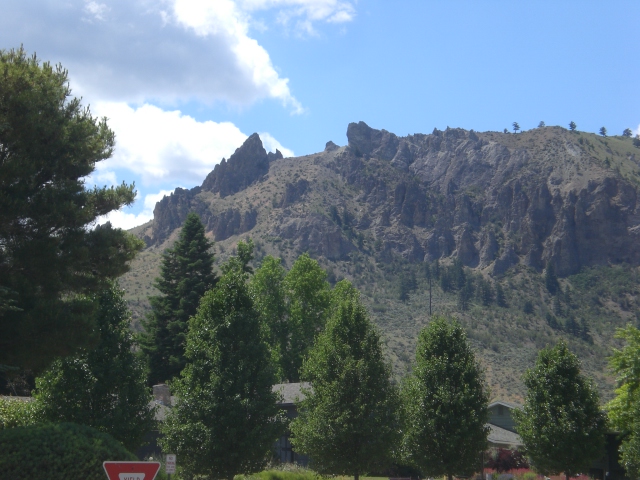
It was the first memorable sight of my new hometown that morning in 1970, when the newspaper managing editor who'd just hired me picked me up at the airport. As we came down the hill en route to the newspaper office, he pointed out a huge, unique land formation on the other side of the Columbia River. “Saddlerock, they call it,” he said. And yes, I could imagine that shape in the rocky crag before us, beileved to be an old volcano's neck. After five years as a reporter and editor, I would move away to other opportunities. When I returned to the valley several years later later to be married, the “saddle” still stood there. Stark, high, and regal.

Many have hiked it, even several times. I never did—busyness and health being my reasons. But in June, “Saddlerock” was the commanding view from the window of my husband's hospital room. He would die, just short of age 78. But, thanks to that physical symbol of our great and mighty God, I would be reminded of the comfort freely offered in Psalm 121:

I will lift up my eyes to the hills, where does my help come from? My help comes from the Lord, the Maker of heaven and earth....The Lord will watch over your coming and going both now and forevermore. (vv. 1, 8)

As I transition into a “new normal” after nearly 42 years of marriage, I sense the hug of God while re-reading familiar and comforting scriptures. The grief fatigue is there. The sense of being overwhelmed is, too. But there's love, too--in food gifts, the flood of cards, the caring visits and phone calls. All said my husband's life (as a Christian, a great dad, a teacher, and all-around friend to many) mattered in theirs. And that meant a lot.

And so does the even-more-stalwart hope and comfort of God. Just the right scriptures come to my sad heart, reminding me that this was not an end, but a transition for someone who loved and served the Lord. Also, that I am the Great Shepherd's lamb, under His protective eye. He walks alongside in the valley of death (Psalm 23).

I'm told that the view from the top of Saddlerock is spectacular. From the “saddle,” you can see the sweep of the Columbia River as it veers from south to east its serpentine journey to the Pacific ocean. And the hills! Gray, scrubby, scruffy, all part of the unique high desert terrain of Central Washington. But be careful from that viewpoint. The other side is a dangerous drop.

And maybe that's a good reminder for this season of life. Not to indulge in prolonged grief or self-pity, but to look to others, and share the hope you have in Jesus. A friend (my long-ago childbirth coach!), who was also widowed this past year, mailed me a card with a caring note, then later just a Bible verse:

Surely God is my help; the Lord is the one who sustains me. Psalm 54:4

This is part of healing a big heart-wound, carrying forth the reality that God comforts us in our troubles “so that we can comfort those in any trouble with the comfort we ourselves have received from God” (2 Corinthians 1:4).

=============

Here is one powerful rendition of Psalm 121 set to contemporary music:

Bing Videos

Friday, March 8, 2019

PROTECTED (PSALM 121)


My mother, whose hobbies included oil-painting, did this art of
Mount Rainier for me. A few months later she died of cancer.
I know I’m in trouble when I lapse into the thinking that “it’s just me against the world.” When I feel overwhelmed by negative people or circumstances, I’m in a downward spiral—until I look spiritually “up”…to God.

I lift up my eyes to the hills—where does my help come from? My help comes from the LORD, the Maker of heaven and earth. (121:1-2)

I don’t lift my eyes to the “ills”—the problems—but to the higher, invisible presence of God.

Some of my reminders to do that come from paintings or photos in my home of Mount Rainier, the 14,000-feet-plus snow-capped, sleeping volcano that squats above the valley where I grew up. In that area’s rainy climate, it wasn’t always visible. But on sunny days, if I went to the end of the street to peek between rooftops, I could see it and report back home, “The mountain is out.” I’m aware that scientists say it could, like Mount St. Helens, cause great damage and loss of life if it ever erupted. Still, whenever I read the opening words of Psalm 121, in my memory I “look to the hills” (and this mountain) because my human tendency in thinking of God is to look “up.” In doing so, I remember that Christ ascended into heaven, wherever that is in the mystery of God.

When I learned that Psalm 121 was one of the psalms “of ascent,” sung by pilgrims headed to Jerusalem (“up” in the hills), I better understood why it referred to the “hills.” These people, traveling to their Holy City, were looking “to the hills” for the first evidence of Jerusalem’s temple. The primitive route there, however, harbored risk. Besides harsh weather, snakes and other animal dangers, they were vulnerable to bandits. But they focused instead on what was ahead: the religious celebrations and reunions with other God-followers. These would remind them that their true help wasn’t in rituals but from their Creator God.

WATCHED
Five times the psalmist refers to God as watching us. He watches us instead of “sleeping” (vv. 3-4) He watches as a protective shade (v. 5). He watches out for possible harm to us (v. 7), and our comings and goings (v. 8). Does that mean bad things will never happen?  Of course not. We experienced “harm” when involved in two serious auto wrecks caused by drivers who were allegedly drinking or just plain careless. But was God there? Of course! In the midst of the frantic and scary stuff, He hadn’t left us.

Paul experienced that through many life-threatening situations—stonings, mob attacks, bandits, intrigue, shipwreck (check out the list in 2 Corinthians 11)--yet left this golden verse in his letter to the Philippians:

And the peace of God, which transcends all understanding, will guard your hearts and your minds in Christ Jesus. (Philippians 4:7)

Bandits called discouragement and doubt still hide behind the boulders of life’s journey. They’re “bandits” because they want to take away what is most precious to us, and that is peace with God. Depression can slither in from such attacks. At such times I need to get my eyes off the rocks in the path and up to the destination: of communion with the God whose ultimate goal is fellowship now and forevermore (v. 8).

Friday, September 12, 2014

Making 'Psense' of Psalms--Psalm 121: Keeper

Part of a continuing series on selected psalms.
The opening verses of Psalm 121 came to mind as I neared the top of a mountain pass in Washington’s Cascade Mountains:
I will lift up my eyes to the mountains;
From whence shall my help come?
My help comes from the LORD,
Who made heaven and earth. (vv. 1-2, 1973 NASV)

The narrow highway gripped the side of a slope as it ascended the pass. I knew that the final curve opened to a splendid, mile-high view of Mount Rainier. Like a mammoth ice cream sundae, it would rise above little “Tipsoo Lake,” a liquid jewel set amidst meadows awash in lupine and other alpine flowers. The site came two hours into a four-hour journey, so I’d pull off for a driving break and just absorb the beauty. More important, the majesty of this setting reminded me of the greater majesty of the Most High God. This same God cared diligently for me, His struggling follower who needed His help.

I drove that route several times that year. I was 31 and still single, struggling through the aftermath of my parents’ same-year deaths. I’d dropped out of graduate school and moved 2,000 miles back “home” to clean out their house and prepare it for selling. From time to time, I’d travel across state to the home of my sister, my only sibling, to help with her young family and business.

I’d been seeking the face of the Lord in the valleys, too, and appropriately my childhood home, to which I was returned, was in a “valley.” In the midst of sorting out my parents’ belongings and holding estate sales, I battled discouragement and fear.  Now that I was alone, with no parental safety “net,” who would take care of me? My answers came as I determined to read through the Bible in a newer translation someone gave me. A fresh reading of psalms reminded me that ancient writers also wrestled with what-if’s. Psalm 121 was among those I underlined or starred, my way of noting, “Remember this!”

“Remember this!” is actually a theme of several psalms of which 121 is a part, the “Ascent Psalms” of numbers 120 through 134. “Ascent” literally means “goings-up” and this group was probably sung by pilgrims “ascending” toward Jerusalem for one of three major annual festivals. With an elevation of 2,400 feet, Jerusalem was literally “up,” accessed by primitive roads known for physical and criminal dangers. This accounts for the focus on remembering God’s “keeping” power. In fact, the words “watch over” and “keep,” are the same Hebrew word, shāmar, repeated six times in this psalm.

CREATOR, NOT THE CREATION
When I stopped at this Mount Rainier viewpoint, letting its majesty fill my heart with awe, this wasn’t “mountain worship.” I knew that ancient Native Americans of that area called this “Tahoma,” “the mountain that was god.” I also was aware of a misunderstanding of Psalm 121 that some had from the original King James translation, which began “I will lift up mine eyes unto the hills, from which cometh my help.” Period. Unfortunately, this earlier translation permitted the idea that people were helped or rejuvenated through the “spirit” of the hills or mountains. It’s an ancient idea. Even in Bible times, there were idolatrous worship spots in the nearby hills or “high places.” One prominent “deity” was a goddess named Asherah, connected with degrading sexual practices. Israel’s bad kings left the idolatrous practices alone.  The good kings, like Hezekiah, diligently cleansed Israel of them: “He removed the high places, smashed the sacred stones and cut down the Asherah poles” (2 Kings 18:5). The point is this: neither Mount Rainier, nor any other earthly site, is worthy of worship. But such places can move us to worship the Creator, whose amazing craftsmanship includes these breathtaking places.

The mountain also reminded me that God always was, always is, and always will be. He is so powerful that His sculpturing of 14,410-foot ice-capped volcano took a symbolic flick of His finger. The One who ordered Creation and intervened in human history is worthy of my awe, devotion, and trust.

KEEPER AND WATCHER
Psalm 121 uses the analogy of a journeying pilgrim to remind us of His steadfast help and watch-care.
*He won’t let our feet slip (v. 3a). It was easy for pilgrims to stumble on the rocky, buckled primitive roads. This doesn’t say that God will send in an earth-mover to level the road. Even obedient believers face difficulties and dangers. They deal with emotional and physical pain. God permits that, often for our spiritual growth, but He draws the line at spiritual harm.  

*He won’t sleep on the job (vv. 3b, 4b). This verse reminds me of the almost comic scene in the Mount Carmel showdown between the prophet Elijah and the prophets of the false god Baal. They’d both set up altars, with the understanding that the “real” god would be able to supernaturally ignite the sacrifice. Despite much carrying-on and body-cutting, the Baal-followers couldn’t get results. Elijah taunted, “Shout louder…Surely he is a god! Perhaps he is deep in thought, or busy, or traveling. Maybe he is sleeping and must be awakened” (1 Kings 18:27). Of course, they followed a false, useless God. Soon, Elijah’s God would ignite a pile of wood that had been drenched with water! (v. 29). We have a God of power and constant oversight. He doesn’t have “business hours” for calling His hot line. When needs arise in the middle of the night, He is there as much as during the day.

*He will watch over us (vv. 4, 5). When I care for my infant grandson, I check on him every ten minutes when he naps—and constantly when he’s crawling about the house! So much more are we in God’s watch-care. Of the many other Biblical references to God watching over us, I’ve always been drawn to these: “I will counsel you and watch over you” (Psalm 32:8). “The eyes of the Lord are on the righteous” (Psalm 34:15, quoted in 1 Peter 3:12). 

*He offers shade (v. 5). Like a wide-brimmed hat or shady place might protect us from the full blast of sun or even rain, God shields us spiritually. He is the “shadow of the almighty” of Psalm 91:1.

*He keeps us from harm, day and night (vv. 6-7).  Travelers faced the blistering heat of day and the bone-chilling cold of overnight campouts along the way. In whatever changes we face in life, God is there for us. This isn’t to say that our lives will be like a luxury motel room. Instead, in these challenges we have His presence and power to get through the difficulties that will inevitably come.

*He constantly watches over us, wherever we go, forever (v. 8). “Thy going out and thy coming in,” the King James version says poetically. In the daily routines of life—going out to work, coming in to eat and rest—God watches over us. In our travels, wherever they take us—down the street or across the oceans—God watches over us. Most important, He is committed to doing this forever. This verse has echoes of the beloved Psalm 23, which in verse 6 speaks of “goodness and love” following me “all the days of my life.”  It’s not just the duration of our earthly lives, but forever we enjoy this loving watch-care of God. He is our portion forever (Psalm 73:26).

As the pilgrims neared Jerusalem, and spotted the temple ahead, their hearts must have been full of gratitude that once again they’d made it safely to their destination. Although they knew God didn’t actually “dwell” in that temple (to think so would have been idolatry), it symbolized the relationship of God with His covenant people. They must have sung this psalm with real gusto!

In reading it today, we may not break out in tambourine-shaking joy like long-ago Jews. But when we face our own unknowns and difficulties, and need assurance of God’s watch care, it’s a vital psalm to study and claim. I know its truths sustained me through some of the darkest months of my life. As I revisit it, I am reminded of one big truth.  No matter how deep my pain, or big my problem, God is my keeper and helper-- no matter what.  
Next: Psalm 126

Friday, September 7, 2012

Looking up


My mother painted this version of Mount Rainier for
me in 1978, the year she died of cancer. It's
much like the view of Tipsoo Lake at the
top of Chinook Pass, mentioned in this blog.
 Someone stopped by the house the other day and began anxiously lamenting all the negatives in world news. “Is God still on the throne?” I chided. Every generation will have its negatives, some of which seem to be hurtling our planet toward self-destruction. When worry about these things tries to slither into my heart, I find I need to go back to Psalm 121:

I lift up my eyes to the hills—where does my help come from?
My help comes from the LORD, the Maker of heaven and earth.

This psalm had its greatest impact in my life when I was 32, making numerous trips over Washington’s Cascades Mountains to my sister’s home in Eastern Washington. I was temporarily living in our deceased parents’ home in Western Washington while cleaning it out as part of estate settlement. The four-hour trip included a true apex. At the top of Chinook Pass, I came upon a stunning view of snow-capped Mount Rainier, elevation 14,410 feet.

Often I’d be mulling over my problems and challenges as I drove. But when that mountain came in view, reminding me of God’s power and purity, I got an attitude adjustment. Though I didn’t know how He’d do it, I could trust God for the troubling unknowns I faced.

The Israelites didn’t have Mount Rainier, but they did have Mount Zion, the “big hill” on which Jerusalem was built along the ridge called the “Judean Hills.” The temple hill was Jerusalem’s focus, and in those days the “glory cloud” that signified God’s presence hovered over the Holy of Holies. When they looked to the hills, they had this bright, inexplicable floating mass to remind them that God dwelled among them. Who could be more powerful than the Maker of heaven and earth?

He will not let your foot slip—he who watches over you will not slumber;
indeed, he who watches over Israel will neither slumber nor sleep.

Let me tell you about a “foot slip”! Mine on an icy stairwell changed my life and the anatomy of my ankle. Though the broken bones healed, the arthritis there now is a great barometer for weather changes! But in this case, the psalmist is saying God is the ultimate security. He wants to help us over life’s rocky places. Unlike human guards, who are apt to doze off, He’s on constant alert on our behalf.

The Lord watches over you—the Lord is your shade at your right hand;
The sun will not harm you by day, nor the moon by night.

Most Bible teachers connect these verses to demonic religions that deify the sun and moon. In that context, this verse is a reminder that God is greater than that. First John 4:4 emphasizes: “The one who is in you is greater than the one who is in the world.”

The Lord will keep you from all harm—he will watch over your life;
The Lord will watch over your coming and going both now and forevermore.

This doesn’t mean that nothing bad will happen to us. Instead, nothing will come into our lives apart from God’s permissive will. Bible teacher Kay Arthur often remarks that whatever happens is “filtered through fingers of love” (As Silver Refined, Waterbrook, p. 130). To pull from Romans 8:28, these things happen according to God’s purpose.

God’s enduring care for us shines through the last four words: “both now and forevermore.” His watch-care never ends.

The Bible predicts a cataclysmic end to the world. I don’t know what that will involve. Maybe Mount Rainier will collapse! But I know I don’t need to worry about it. God cares about every detail of my life and will help me through whatever is ahead. And someday, I won’t look unto the hills for inspiration. I’ll look unto the Throne, from whence came my help, and offer all the praise I can muster.

Thursday, February 9, 2012

Love's Point of View

A major river curves through the valley town I call home. The view is magnificent from the foothills, especially a spot that’s well-earned its reputation as “lover’s leap.” Not that local lovers actually leap (as did some historical lovers elsewhere, giving us the nickname)--but you get the picture. I like the view from there during the daytime, as it takes my heart to the opening verse of Psalm 121: “I lift up my eyes to the hills—where does my help come from? My help comes from the Lord, the Maker of heaven and earth.”

In recent blogs I have used photos of natural things--swamps, rocks, birds, and paths—for often it’s in the midst of God’s creation that we re-encounter the truths about Him. Psalm 121 is just one example. Years ago I shared with a friend how its imagery of "looking up to the hills" helped me during uncertainty and loss. Later, she wrote me how much she appreciated thinking of the psalm that way. In verses 1 and 2, “looking up” reminds us of how we instinctively look “up” to heaven, and also recalls how Christ ascended to Heaven through a cloud until He was seen no more. Though we don’t know Heaven’s location, God has given us the visual of “up.” “The hills” are a symbol of strength—God Himself, who orchestrates whatever help we need through circumstances and through the human agents of spiritual leaders, other believers, family and friends.

Starting with verse 3, the psalmist affirms God’s character and trustworthiness. It’s helpful to remember that this psalm was one of the “ascent” songs that pilgrims sang as they “ascended” into the highlands where Jerusalem was situated. In those days of primitive transportation through hostile areas, anything could have happened. Feet could slip on rocky, narrow trails. Travelers could be attacked while asleep at night beside the road (Psalm 91:5 alludes to this, too). They could get dehydrated and sick as they traveled on hot days. But, says verses 7-8, they depended on God to keep watch over them.

Reality check: what about the old question of why bad things happen to good people? Jesus clarified the answer in Matthew 10:28: “Do not be afraid of those who kill the body but cannot kill the soul. Rather, be afraid of the one who can destroy both soul and body in hell.” God is not the author of sickness, suffering or death. If they come into our lives, it is with His permissive will to accomplish His higher purposes. Everything filters through His loving hands.

Especially at this time of year, when our world puts a sentimental and materialistic spin on "love," we need to remember that human love fails us. Valentine's Day can be painful. Not everyone will get a card, flowers, candy, jewelry, or whatever else is advertised out there. There may be heart-breaking loss or hopes that were never fulfilled, making this commercial holiday especially painful. That's why we need to keep the big picture in mind. We need to look up to the One Who knows our comings and goings, and Who anticipates our final coming to Heaven to live with Him forever.

The "point of view" of God's love has no equal. Our Heavenly Lover awaits for us to leap in faith into His arms!