|
Lambs from the flock of one of my friends. She was always
glad to show her sheep to visitors. One time I took my mother-
in-law, then in her 80s, who thrilled to bottle-feed an orphan lamb. |
"Is it a need or a want? That phrase sometimes came into family
discussions about things our children’s friends had, and they didn’t. Living on
a school teacher’s salary meant lowered expectations of “want,” while thanking
God for giving us what we needed.
I sometimes
think of that when I read the first verse of Psalm 23 in four-hundred-year-old
vocabulary: “The Lord is my shepherd, I shall not want.”
Read through the linguistic lenses of the 21
st
century, it seems to imply that we will have no expectations, no desires--something
like zombies. Nothing could be further than scriptural truth. More accurately,
as some translations render it, “I shall not be in want.” Or, “I shall lack
nothing.” The God who formed every fiber of my being, and knows my innermost
thoughts, is my provider in every way: body, mind, and spirit.
Our
understanding of this beloved psalm was given a boost with the 1970 release of
Philip Keller’s A Shepherd Looks at Psalm
23. A pastor and author, for eight years Keller was a shepherd, gaining
insight into the tasks so perfectly applied as Psalm 23’s spiritual metaphor. Although
Jesus, like other Jewish boys, learned his father’s life skill—in this case,
carpentry--we don’t think of him as “Jesus, the Good Carpenter.” Wood is
inanimate and yields to the saw, hammer, and chisel. But sheep are very needy
living creatures—yes, mostly “dumb.” They need a caring, wise shepherd. As this
psalm reveals, we are so much like them, in need of a Good Shepherd.
Even the
first five words of this psalm are like taking the hand of our loving, caring
God.
Someone once suggested meditating
on each word by itself.
“
The”—the
only one, the holy one, the unique one.
Not plural. Singular.
“LORD”—the small-capital-letter name in English
Bibles for “Yahweh,” the holy covenant name of God given in Moses’ times: “I am
who I am” (Exodus 3:14).
“Is”—not
“was,” as in a former deiety, but “is” for now and forever. In a gift book
titled
Safe in the Shepherd’s Arms, Max
Lucado said that David wrote this psalm to remind us of who God is: the Yahweh
who is unchanging, uncaused, and ungoverned (Nelson, p. 13).
“My”—yes,
others’ shepherd, but also personally, intimately mine. I am not too
insignificant for Him.
“Shepherd”—not
an impersonal deity who demands worship and who is as capricious as the winds,
but a caring, nurturing, sacrificing God who tends to every detail of my life.
SHEPHERD VIEWPOINTS
Seasoned
Bible teachers, in trying to outline Psalm 23, only prove that it cannot be
studied enough. Warren
Wiersbe, well-known for his “Be-“ study series, included this psalm in “Be
Worshipful” and divided it like this:
*In the
pasture—Adequacy (vs. 1-3)
*In the
valley—Serenity (v. 4)
*In the
fold—Certainty (v. 5)
*In the
Father’s house—Eternity (v. 6)
Derek
Kidner, a commentary-writer who ferrets out meanings of original languages,
gave this outline:
*The
Shepherd (1-4)
*The Friend
(5-6)
William
MacDonald, who compiled a layman-friendly Believer’s
Bible Commentary, said that this outline by J.R. Littleproud (from the
1930s) was hard to improve on:
*The secret
of a happy life—every need supplied.
*The secret
of a happy death—every fear removed.
*The secret
of a happy eternity---every desire fulfilled.
James Montgomery
Boice, who preached on psalms for nearly three years from the pulpit of a huge Philadelphia church, outlined
off the statement: “Because the Lord is my Shepherd”:
*I shall
not be in want.
*I shall
not lack rest.
*I shall
not lack life.
*I shall
not lack guidance
*I shall
not lack safety.
*I shall
not lack provision.
*I shall
not lack a heavenly home.
A SHEEP’S SURVIVAL VIEWPOINT
The sheep
needs its shepherd for
everything. It
needs led to good pasture, free of poisonous plants. Once there, the sheep
needs to be free of fear. The flock cannot be agitated by bully sheep. Those
afflicted by insects or skin diseases (for which ancient shepherds carried a
salve of olive oil, sulfur and spices) must be doctored.
Yes, their heads anointed with oil (v. 5). The
water must be clean and calm. A sheep needs enough food to feel full.
The sheep
need a protector. Some, in their stupidity, would lie down in a hollow and lose
their balance, unable to right themselves. These “cast” sheep were at risk of
death within hours as gases built up in the body. A shepherd had to “right” the
heavy sheep for it to survive. The shepherd also protected from wild animals.
Remember how David boasted to Goliath that God had delivered him from the paws
of the lion and bear (1 Samuel 17:37)? He had no gun, just his rod, slingshot,
and physical power. When sheep were herded into a rock-fenced sheepfold at
night, the shepherd slept across the entrance.
The
shepherd was intensely loyal to his own sheep, even knowing the name of each. A
hireling shepherd had no such attachment and would run away if danger came
(John 10:11-13). In calling Himself “The Good Shepherd,” Jesus committed to the
responsibility of total, loving care for His own followers.
THE SHEEP’S REVIVING VIEWPOINT
As humans
created in the image of God, we have something sheep don’t—an anticipation of
something beyond the grave. How many, on their deathbeds, have found
unequivocal comfort in these concluding words?
Surely goodness and mercy shall follow me
all the days of my life, and I will dwell in the house of the LORD forever.
(Psalm 23:6)
That statement has a “present”
and a “future.”
“Surely” means “without
doubt,” “absolutely.” Some say “goodness” and “mercy” are like two sheepdogs
that guard the back of the flock. As the Shepherd leads us through life, every
circumstance is under His scrutiny. Health issues? Heartaches? Stressful days
at the job or at home with children? Worries? Sorrows? God is with us
all the days of our lives. He may come
in the quiet joy of nature’s gifts. A kind word or deed. A recalling of past
mercies. Beautiful music. That private, overwhelming realization that He will never
leave me or forsake me, no matter how bad things seem right now.
He is
trustworthy. He will see us through to
His house. Forever.
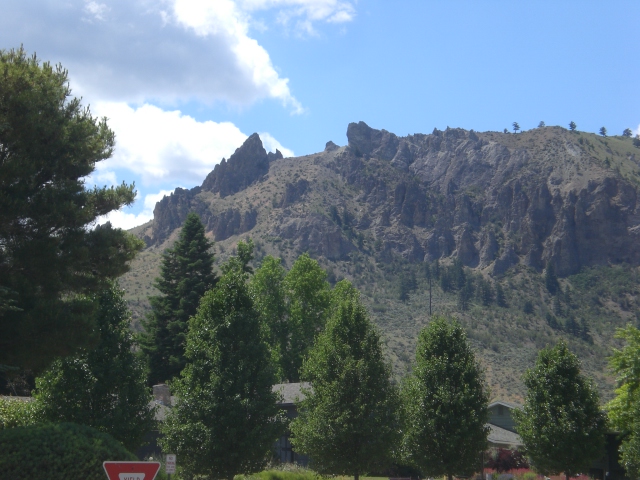 It was the first memorable sight of my
new hometown that morning in 1970, when the newspaper managing editor
who'd just hired me picked me up at the airport. As we came down the
hill en route to the newspaper office, he pointed out a huge, unique
land formation on the other side of the Columbia River. “Saddlerock,
they call it,” he said. And yes, I could imagine that shape in the
rocky crag before us, beileved to be an old volcano's neck. After five years as a reporter and editor, I
would move away to other opportunities. When I returned to the valley
several years later later to be married, the “saddle” still stood
there. Stark, high, and regal.
It was the first memorable sight of my
new hometown that morning in 1970, when the newspaper managing editor
who'd just hired me picked me up at the airport. As we came down the
hill en route to the newspaper office, he pointed out a huge, unique
land formation on the other side of the Columbia River. “Saddlerock,
they call it,” he said. And yes, I could imagine that shape in the
rocky crag before us, beileved to be an old volcano's neck. After five years as a reporter and editor, I
would move away to other opportunities. When I returned to the valley
several years later later to be married, the “saddle” still stood
there. Stark, high, and regal.