Showing posts with label Psalm 37. Show all posts

Friday, July 12, 2019

PATIENCE!


Somewhere, long ago, I saw this sign. I should have bought it, because it is so "me"!
I want patience, and I want it right now!
With maturity comes the realization that patience is a slow-brewed quality. It takes time to ripen that personality trait.  Like sauerkraut.  Well, maybe cabbage to sauerkraut isn’t the best illustration. Maybe cheese? Instead of the petulant “right now” slogan, I’ve mellowed to appreciate this one:

Often, when things aren’t going my way, or happening as fast as I want, I am drawn back to an old friend, Psalm 37.  It has hard words like “fret not,” “trust,” “delight,” “dwell,” “commit,” “be still,” “refrain from anger,” and “a little while.”
I once heard “fretting” called a “spiritual heartburn.” It’s the acid of impatience that wants its own way and timing, not God’s. Over and over, God has to remind me:

“Be still before the LORD and wait patiently for him.” (v. 7)

Sometimes He wants me to stop and change direction.  Sometimes He just wants me to stop trying to manipulate an improbable or impossible situation. My Plan A or Plan B are just plain wrong.  His Plan C, even though it may take more time, is far better.

That’s where prayer enters into the situation. The unchangeable God is the One who can break down stubborn wills or circumstances thought to be unchangeable. That’s why I keep praying for people and circumstances that left me wounded.  I can’t change them. But God can. My job is to aspire to greater godly character. It’s what the psalmist describes as righteousness, blameless, generous, faithful, uttering wisdom, speaking what is just.

I’ve been the victim of someone’s “rage”—an angry outburst full of lies and misinformation. When that person left, I realized I was trembling from this emotional wounding. But I also asked the Lord to help me look with His eyes on this troubled person. I can’t fix the world. But I can leave those problems in God’s lots-capable hands. 

Do not fret, trust, delight, commit your way to Him, be still.  Good things do take time, when they’re left to God’s perfect time.

Friday, September 14, 2018

TRUST (Psalm 37)


Who's in the driver's seat?  I chuckled when I saw this dog had taken 
over his owner's seat in front of the steering wheel. I wouldn't trust
my life to this furry driver!  But there's truth in this humor--how often 
do we think we can go solo without God at the controls? 
A series on the 48 psalms recommended for times of depression by pastor/counselor David Seamonds, author of Healing for Damaged Emotions.

I was a young Christian, struggling to trust God in all the changes of young adulthood and first job, when I came to Psalm 37 in my Bible reading. I’m sure I’d read it before, but the challenges and disappointments I was then facing made it almost throb with truth for my particular circumstances.

Trust in the Lord…Delight yourself in the Lord…Commit your way to the Lord…Be still before the Lord.

This represented a shift in thinking for me. I’d just come out of college where diligence and planning were rewarded with academic honors. I was the ultimate planner whose desk calendar was full of deadlines to achieve so I wouldn’t come to “Dead Week” (finals) half-dead. The work world was different. I put on a lot of unpaid overtime to meet my workload expectations. I had a boss with a deserved reputation for being hard to please. I felt I had good work relationships with my colleagues. But for many, Jesus wasn’t first in their lives, and as a believer, I felt lonely. When a young Christian man came into my life, I felt I was about to see God fulfill verse 4:

Delight yourself in the LORD and he will give you the desires of your heart.

But the relationship ended. I wondered, had I missed “the desire of my heart” because I hadn’t delighted enough in the Lord?

ROLL IT OFF
I also missed the meaning of “Commit your way to the Lord.” It wasn’t like signing a mortgage agreement. Instead, the verb in Hebrew means to “roll off your burden.” God has stronger shoulders than I do, especially when I’ve been slandered. Instead of limping around with somebody’s negative words hanging on me like a burdensome backpack, I’m to roll that ugly, demeaning load into His care.

I feel I’ve barely begun to understand and live out Psalm 37. But it always encourages me to see God as a gracious, loving Father who understands all the disappointments we face as we live in an imperfect world. He will satisfy all our desires. This is not to say He will give us all the “things” we think we need or are “entitled” to, but He will satisfy those who want more of Him in their lives.

David wrote this psalm in his old age, when he had the time and experience to deal with the puzzle of why the wicked seem to prosper and the righteous suffer. I’ve wondered about that too, as some sort of “suffering” has been a part of every decade of my life. But I’ve also known the blessing and mercy of the Lord, and I think this is what Psalm 37 is getting at. These, for me, are some of its key verses:
Be still before the Lord and wait patiently for him; do not fret when men succeed in their way, when they carry out their wicked schemes. Refrain from anger and turn from wrath; do not fret—it leads only to evil. For evil men will be cut off, but those who hope in the Lord will inherit the land. (vv. 7-9)
In other words, the end of the story hasn’t yet been written. The wicked may seem to be in control now, but their drama on this fallen earth isn’t forever: “The Lord laughs at the wicked, for he knows their day is coming” (v. 12). Just wait, God says--patiently (v. 7). He won’t disappoint.

Friday, April 4, 2014

Making 'Psense' of Psalms--Psalm 37: The Meek and the Mean

Part of a continuing series on selected Psalms.
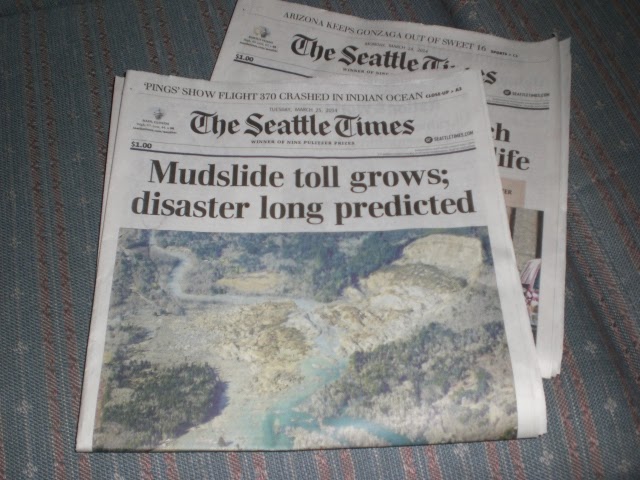
“In three seconds, everything washed away,” The Seattle Times headlines read on March 23, 2014.  The previous day, an entire rain-drenched hillside collapsed, smothering a small community in mud and debris. Some victims were trapped in their homes as the structures were torn from foundations. The disaster was quickly ranked as among the state’s worse, up there with the volcanic eruption of Mount St. Helens, earthquakes and horrific windstorms. As I processed the news coverage of this sad, unexpected disaster, I was also thinking of lessons from my study of Psalm 37. Only God knows the true spiritual condition of each who died, and some were likely solid Christians. But the enormity of the landslide made me wonder what will happen at the end of time, when Psalm 37 says the wicked will be destroyed. Jesus also taught about the sobering suddenness of events when He returns: “Two men will be in the field; one will be taken and the other left. Two women will be grinding with a hand mill; one will be taken and the other left” (Matt. 24:40-41).
 
Psalm 37 is one of seven acrostic psalms, built off the Hebrew alphabet. In Bible times, alphabet songs helped teach spiritual truth to children and adults. The big idea behind Psalm 37 is finding spiritual peace in the midst of the age-old battle between good and evil. Or, to simplify it to two “m” words, between the “meek” and the “mean.” Verse 5 is a key: “The meek will inherit the land and enjoy great peace” (37:5). In His sermon on the mount, Jesus reiterated that truth: “Blessed are the meek, for they will inherit the earth” (Matt. 5:5). He didn’t elaborate, but David had already, hundreds of years earlier, in this psalm.

MEEKNESS
The same Hebrew word for “meek” in Psalm 37:11 (anayw) was also used to describe Moses’ humble reaction when his siblings criticized Moses’ choice of a wife: “Now Moses was a very humble (anayw, “meek” in KJV) man, more humble than anyone else on the face of the earth” (Numbers 12:3 NIV). A common definition of this Biblical trait is “strength under control.” Moses lived out the proactive responses David gave in Psalm 37:
 “Fret not”—literally, don’t get heated up. Stay cool. As if for emphasis, “fret not” is repeated in verses 7 and 8. It’s easy to fret when bad seems to be winning out, and bad people seem to prosper, but God says keep the long view in mind.

 “Trust in the Lord”—Trusting in God includes practical steps of doing good and doing your best in your circumstances (“dwell in the land”).

“Take delight in the Lord”—Delighting in the Lord shows others that He is worthy of our love and worship, not the frowning, legalistic deity that non-believers tend to see Him as. The promise to give us the “desires of our heart” means that when our desires match up with His, we will know those blessings. It’s not a cart blanche promise to receive any frivolous thing out there.  Sometimes God needs to protect us from our unwise desires.

“Commit your way to the Lord”—The original language is a picturesque term of “rolling off our burdens.” Years ago, visiting a banana planation in Panama, I watched workers shouldering huge just-cut stalks, laden with dozens of green bananas.  They took these burdens to trailers, gently rolling them off into padded platforms. Similarly, God says to roll our burdens onto Him—as 1 Peter 5:7 expresses it:  “Cast all your anxiety on him because he cares for you.”

 “Be still before the Lord”—Waiting on God goes hand-in-hand with waiting patiently for His perfect timing. David put it another way in Psalm 62:5: “Find rest, O my soul, in God alone; my hope comes from him.”

“Refrain from anger”—God wants us to guard against anger, instead fully trusting Him when facing injustice and disappointment.

MEANNESS
Psalm 37 gives various names for the “mean”: “the wicked” (14 times in the King James version), “those who do/are evil,” “who do wrong,” “who carry out wicked schemes,” “those he [God] curses,” “enemies,” “wrongdoers,” and “sinners.” This conflict between the “godly” and the “wicked” goes back to God’s covenant with Israel, told in Leviticus 26 and Deuteronomy 27-30. If Israelites obeyed God, they could live in the Promised Land and enjoy its blessings—the reason behind “the land” or “inheritance” repeated eight times n Psalm 37. If they disobeyed God, they’d be chastened by invasion, drought, or famine. Chronic disobedience would mean removal from the land—which is exactly what happened during 70 years captivity under foreign rulers.

In David’s time, however, hundreds of years before captivity, the faithful saw wicked people prospering, contrary to their thinking that God should only prosper those who followed Him. In this psalm, David was teaching them to trust God’s character. He would punish the wicked—and thoroughly: “All sinners will be destroyed; there will be no more future for the wicked” (v. 38). In the meantime, they weren’t supposed to give up on the Promised Land and move elsewhere (as did Naomi’s family in the book of Ruth).

Our modern economy has changed customs of inherited lands. One good result of this is the freedom to move to different places to do God’s work. On the other hand, it allows people to give up when God might want them instead to stay and work through problems. One who has learned to listen to God’s call to “wait” or “go” is Edith Schaeffer.  Her words in Common Sense Christian Living (Nelson, 1983, p. 227) are worth considering: “You and I often want to know, ‘What comes next?’ God is saying, ‘Trust Me,’ He is saying, ‘Stay in the place where you are until I show you [in a variety of ways, usually not mystical at all] what comes next.’ He is saying, ‘Blessed is the person who waits in the dark, holding My hand.’”

One more important reason to stay put: our witness to the “mean” or ungodly. This quote by 19th century preacher Charles Spurgeon says it well: “If sinners be damned, at least let them leap to Hell over our bodies.  If they will perish, let them perish with our arms around their knees.  Let no one go there unwarned and unprayed for.”  That’s a “bold” assignment for the “meek”!

Friday, August 26, 2011

On Bravehearts


This week my daughter and her husband (left in the photo) stepped into a profound list of “firsts” as they begin a new chapter of life in China. He will teach English at a large city university, and she will—well, we’re not sure. We’re hoping her extensive music skills will find an outlet.

My memory went back over other firsts in her life. Her first breath (a girl!), those first steps, first day of pre-school…I’ll skip the many childhood firsts and get on to the first day of being a licensed driver, first day away at college, first day away at grad school, and her first day as a bride and wife.

Now--oh, the places she will see and the people she will meet.

As she acclimates to new surroundings and especially a new culture, I think back to times my comfort zones were stretched. Though I did go outside the U.S. borders a few times, most of my changes were within the U.S. and didn’t involve a strange language, “what’s that?”-food choices, masses and masses of people, and less-than-ideal sanitation. But when my parents died and I was on my own 2,000 miles from my “roots,” I did struggle with feeling I didn’t fit in…until some scriptures grabbed my heart.

One was Psalm 37:3: “Trust in the Lord and do good; dwell in the land and enjoy safe pasture.” Three verbs stood out: trust, do, enjoy. I chose to trust that even in the negatives, God wouldn’t leave me. I had to take the initiative to do good in the tasks and relationships that unfolded. Then, in a pastoral image, I was to enjoy this place where the Shepherd had led me to graze.

A few pages later, in Psalm 68, came another reminder of God’s love to those with missing links in their earthly families. Mindful of the dangers of self-pity (“the rebellious live in a sun-scorched land,” v. 6), I connected as soon as possible with a church and volunteered in its ministries. I was there only a year before moving away, but because of those connections, thirty years later I am still in touch with one precious couple from there.

One more Bible passage, Jeremiah 29, spoke to me about accepting God’s plan about living in a new place. The circumstances surrounding this passage were a bit different than mine, as the Jews’ move to exile in Babylon came about as a result of punishment, not a step of faith. I cannot begin to imagine what it was like to travel by foot or pack animal, under the uncaring prods of enemy soldiers, over the deserts to the land of their conquerors. But once there, God didn’t want them to give up. The prophet Jeremiah gave them God’s instructions: to accept this foreign land as their home for now. Family, farming and commercial life were to go on, and they were to seek the peace and prosperity of this adopted homeland (v. 8).

Many may not realize that Jeremiah’s letter was the context of the golden words of hope in verse 11: “’For I know the plans I have for you,’ declares the Lord, “plans to prosper you and not to harm you, plans to give you hope and a future.’”

Many also forget that this promise is immediately followed in verse 12 by the obedience of prayer: “Then you will call upon me and come and pray to me, and I will listen to you. You will seek me and find me when you seek me with all your heart.”

Prayer has covered this move for my daughter and her husband. I believe they will “trust, do, and enjoy” in this land away from their homeland. And even when I can’t hug them in person, I’ll be hugging them in my heart as they encounter many, many “firsts.”