Showing posts with label roots. Show all posts

Friday, December 4, 2015

Big trees, bigger choice

Continuing a series inspired by sights of Kauai, which we visited on a trip gifted to us.
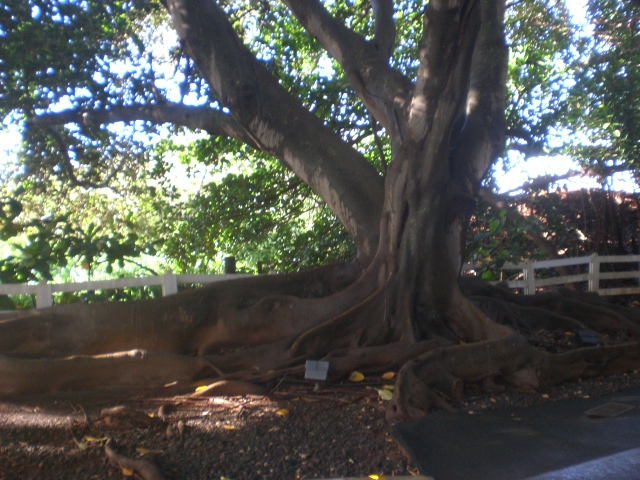
They’re sometimes called “trees on steroids,” the huge Moreton Bay Fig trees that grow seven times faster in Kauai than in their native Australia.  This tree, growing near the hotel where we stayed, is a youngster next to ones featured in the south-shore Allerton-McBryde botanical gardens. One, called the “Jurassic Tree,” was featured in the dinosaur movie “Jurassic Park,” whose filming began on Kauai in 1992. In the story’s plot, dinosaur eggs were found at its base, and from there ensued the high-drama conflict with wild mega-beasts. I never saw the film, but its theme song (which I heard in an Olympic figure skating competition about that time) was scary enough for me.

Tourists today can find the fictional “egg nest spot” amidst the Jurassic Tree’s huge buttressing roots, many as tall as a person.  These trees can grow to 200 feet high, have evergreen leaves, and impair growth of other trees around them.

Learning that reminded me of two similar passages about trees, one in Psalm 1 and the other in Jeremiah 17. Both tell of trees planted by a water source, unbothered by heat, reliably producing fruit. The analogy is to a believer, grounded in God’s Word, sustained by scripture, and producing spiritual fruit.  Then both swing to the negative:
“Not so the wicked! They are like chaff that the wind blows away.”  (Psalm 1:4)

“The heart is deceitful above all things and beyond cure. Who can understand it?” (Jeremiah 17:9)

Right now, two trees grow, as it were, in life’s garden. One is good, bountiful, beneficial, made up of Christians who believe they are called to serve their Lord through service to others.  Then there is an unruly tree that strangles anything around it. As Matthew Henry said long ago in his classic commentary:

The heart, the conscience of man, in his corrupt and fallen state, is deceitful above all things. It calls evil good, and good evil; and cries peace to those to whom it does not belong. Herein the heart is desperately wicked; it is deadly, it is desperate.

Calling “evil good, and good evil”—is nothing new? But it’s not a terminal condition. . Those who’ve lived apart from God can turn to Christ. So turning, Henry wrote, gives them “new desires, new pleasures, hopes, fears, sorrows, companions, and employments. [Their] thoughts, words, and actions are changed. [They] enter on a new state, and bear a new character.” 

Psalm 1 ends with the fate of those who reject God:  “perish.” I consider that destination more horrific than an imaginary monster story filmed in Kauai.

Friday, November 6, 2015

Properly propped

(A continuing series based on photos taken in Kaua’i, the Hawaiian islands.)
If you’ve never seen a hala tree before, you might think somebody didn’t plant it deep enough to cover up the roots. But it is what it is, distinguished by a main trunk and numerous “brace trunks” or “prop roots” that help anchor it to the ground, offering the tree greater stability in storms. Top-heavy palm trees aren’t so fortunate when winds bombast the island, but the stout anchor systems of the hala trees works in their favor.

What a wonderful illustration they provide of Paul’s concern for the Christians of Colossae:
So then, just as you received Christ Jesus as Lord, continue to live in him, rooted and built up in him, strengthened in the faith as you were taught, and overflowing with thankfulness. (Colossians 2:6-7, boldface emphasis added)

“Rooted” refers to our beginnings as Christians at conversion. Jesus is like the soil from which we draw our spiritual nourishment.  The deeper the root—or, in the case of the hala tree, the more connections with Him-- the more we will grow.

In His parable of the sower (Matthew 13), Jesus told of a plant that grew quickly but then withered when the sun came out because the roots were shallow. It surely couldn’t have been a mature hala tree!

In his letter to the Ephesians, Paul echoed his concern for deep spiritual roots:
I pray that you, being rooted and established in love, may have power, together with all the saints, to grasp how wide and long and high and deep is the love of Christ. (Ephesians 3:17b-18, emphasis added)

Taken together, these verses tell the way to a solid, growing faith—like “prop roots” of the hala tree:

1. Authentically rooted in Jesus (that’s the main root).

 2. Built up with faith-strengthening teaching.

3. Practicing the grace of thankfulness.

4. Receiving and giving out Christ’s love.

5. Going even deeper in discovering the love of Jesus.

The result is what Paul described at the end of that chapter, words so awesome and hopeful that they need to have a “Hallelujah Chorus” sung behind as they are read:
Now to him who is able to do immeasurably more than all we ask or imagine, according to his power that is at work within us, to him be glory in the church and in Christ Jesus throughout all generations, for ever and ever! Amen! (Ephesians 3:20-21)

Friday, June 12, 2015

Roots and blisters

I made a blistering attack against our lawn dandelions the other week.  Yes, “blistering,” for my garden “poker” gouged a large, painful blister in my palm. Despite my best efforts, most of the roots broke off mid-way down, giving then a second chance to bloom. Indeed, they did, their sunny heads turning to airborne seeds that laughed “Gotcha” before I could attack the offspring. Oh, those rascal roots of our fallen, weedy world. I’m grateful the Bible gives us another picture of good roots: “I pray that you, being rooted and established in love…” (Ephesians  3:17).
 
Rooted in love.  That was big on Paul’s mind as he reflected on his ministry of taking the Gospel message to Gentiles—that is, the rest of the non-Jewish world. I like how the Amplified New Testament  opens up the English equivalents of the original Greek of this text:  “May Christ through your faith [actually] dwell—settle down, abide, make His permanent home—in your hearts! May you be rooted deep in love and founded securely on love.”

I recently read a helpful word picture of “rootedness” while reading Leighton Ford’s book The Attentive Life. He told of the day he and a friend took a hike and came to two hardwood trees perched on top of a large boulder. Unable to draw sustenance from rock, the trees had grown a long root system that snaked over the boulder to the soil below. “As we looked at this ingenious root system, it seemed to pose a question: What is the root system of my life?  Is it deep and wide and long and strong enough to withstand the pressures of each day?" (The Attentive Life, IVP,2008, p.82).
 
Paul adds to the picture of “love roots” in this passage:  “Just as you received Christ Jesus as Lord, continue to live in him, rooted and built up in him, strengthened in the faith as you were taught, and overflowing with thankfulness” (Colossians 2:7).  The result of “love roots” is the flower of gratitude!  I re-read that verse after an blistering encounter with an ungrateful person who has some significant "anger" roots. That person's high on my prayer list!

But thankful for dandelions? Okay, I can find some reasons. They're  a cheerful yellow that begs to be picked for a bouquet for mommy.  Doing that is a rite of passage for little children, right?  Plus, I’m due to teach my toddler grandson the fine art of blowing off their woolly seed heads. I’ll try to time it so the wind doesn’t blow them into my neighbor’s yard!  


Friday, October 4, 2013

Mushrooms and Psalm 1


Talk about “night visitors”! As I went outside juggling a basket of wet laundry, I almost stepped on some surprise squatters. These brown umbrella disks had popped overnight through some scraggly grass where I’d overwatered. If you didn’t know, a mushroom is a fast-growing fungus that feeds off decaying matter and is common in moist places. I knew they wouldn’t last more than a few days, but went ahead and snapped them away, depositing them in the garbage.  I’d recently studied Psalm 1 and toyed with how verse 3 (about the godly man) would read if mushrooms were substituted for that tree planted by streams of water:

He is like a mushroom that pops up in moist places. He feeds on decay, and in a couple days withers away.

Obviously, the analogy doesn’t work. The psalmist made the perfect analogy to a sturdy fruit tree whose roots grow deep, producing fruit season after season. The application, of course, is sending out deep spiritual roots that will support the growing of spiritual fruit.

This is the growth process J. Oswald Sanders wrote about in The Joy of Following Jesus: “It is the responsibility of the disciple to be the best he or she can be for God.  To please Him is a most worthy aim. He wants us to realize the full purpose of our creation; He does not want us to be content with bland mediocrity” (Moody, 1994, p. 63).

Perhaps it’s because I’m so aware of media addictions that this quote burns into my heart. The “mushroom mentality” feeds on the world’s decay, widely served up enticingly with the click of a computer mouse or a TV remote. Every morning, for example, when I open up my computer’s “home page” to check the weather or start some research, I’m blindsided by what someone thinks is “news” or “trend.” The computer helps me as a writer on spiritual topics, but I could waste hours following cutesy animal videos, celebrity gossip, fashion, sports, games, or personal trivia.

Sanders hit it on the nail: “Many fail to achieve anything significant for God or man because they lack a dominating ambition.  No great task was ever achieved without the complete abandonment to it that a worthy ambition inspires.” How we use our time is a choice—for good or bad. Sanders cited the story of Thomas Scott (1747-1821), who was the low-achiever of his school.  In those days they called him the “dunce.”  Most of his teachers expected little of him.  But someone, somewhere, said something that awakened in him a master ambition.  Slowly, steadily he worked toward it. Sanders continued, “He grew to be a strong and worthy man”—so well-regarded that he succeeded John Newton (former slave trader-turned-believer, best known for “Amazing Grace”) as rector of the church at Aston Sandford.
 
He also wrote a large commentary on the whole Bible that influenced his generation and is still consulted. Scott didn’t achieve that feeding on the decay of the world.  His roots went down deep with God. His life yielded fruit. His leaves didn’t wither. What he did, prospered.

“Mushroom” choices aren’t anything new. The apostle Paul anguished over those he saw in his times, and encouraged stronger believers to help those so entrapped. But he offered a warning for the “helpers” as well: be careful. His counsel in Galatians 6:1 (at right) is a good “screen saver”!