Showing posts with label trees. Show all posts

Friday, December 12, 2025

MIST-TERY

When my home was first built, more than forty years ago, this tree was barely thigh-high when planted. I'm not good as guessing heights, but I think it's more than twenty feet tall. It commands a corner of the front lawn. No, I don't string lights on it at Christmas, but it's “evergreen-ness” is a regular reminder of God's amazing plan for plant life. This tree quietly sheds some needles, but just across the fence, my neighbor's willow generously drops its autumn-yellowed covering. (You can see some of its branches just to the right.), Leaf-fall and fall-mist seem to be constant cousins, painting their own canvas of a land settling in for winter's chilling pause.

I recently came across this quote: “The past is history, the future is a mystery, the present is a gift. Every day is a gift—that's why it's called a present.” For those of us who live in cooler climates (with the vivid change of seasons), the cycle of winter-spring-summer-fall brings vivid reminders of a Divine plan even for earth's weather. A season to grow. A season to rest. A reason to awaken and grow again.

My three grandsons were here the other night for dinner. I'd already wrapped their Christmas gifts, which sat in a pile in the living room. Oh, they noticed those! Snicker, snicker, pinch, pinch. They've probably figured out the contents—the typical Grandma-sewn pajamas, now a holiday tradition. Last year they begged to open their gifts after the Christmas eve service, and promptly, one-by-one, dashed into the bathroom to change from “regular clothes” to their new Pj's.

The next morning, they would tear into the “stash” under their family's Christmas tree, including kits of all those little snap-together plastic blocks. You know the ones—their name starts with the letter “L.” Their current “cache” (a full storage bin) isn't enough to their little minds. There's always the “new kit” with a new project to build “just out” and beckoning....

And maybe there's a comparison here between a growing tree and a growing pile of tiny plastic play-blocks. Each has its purpose—the one to sustain the environment, the other to “grow” little minds. The blocks certainly “trained” their dad's mind to “configure” and “connect.” He became an electrical engineer.

Back to that tree. Who would have imagined its steady growth from a “wee thing” to a giant of needled green beauty? And so it should be with us, spiritually. Planted in faith, nurtured with the Word, we are to “grow in the grace and knowledge of our Lord and Savior Jesus Christ” (2 Peter 3:18). And when those spiritual growing pains come—when life is hard—to remember: “Tribulation produces perseverance, and perseverance, character, and character, hope” (Romans 5:3-4).

Not wimpy, half-hearted, mist-blurred “religion,” but stalwart faith in a loving God.

Friday, July 29, 2016

Close to thee

“Close to thee.”  That phrase came to mind one recent afternoon when I noticed two trees growing unusually close together.  A small tree--an offspring of the bigger one?--was snugged right next to the bigger tree. Why, I'll never know, but the sight reminded me of the hymn that begins:

Thou my everlasting portion,
More than friend or life to me;
All along my pilgrim journey,
Savior, let me walk with Thee.
Close to thee, close to Thee,
Close to thee, close to thee;
All along my pilgrim journey,
Savior, let me walk with Thee.

If hymns are part of your spiritual music fabric, you may recognize the lyrics as coming from the mind of blind Fanny Crosby (1820-1915). She’s generally credited with more than 800 hymn lyrics, many still well-known.

In this case, the music came before the words.  A Long Island, New York, man, a hat-maker by trade, was also a musician who composed Gospel music. When he came up with this tune, he invited Crosby to listen as he played it on the piano. Afterwards, she remarked, “That refrain said ‘Close to Thee, close to Thee, close to thee, close to Thee.” Then, with her remarkable memory and command of rhyme, she composed and dictated the hymn’s three verses, all of which have that refrain.

We’re apt to forget how much of a life story is reflected in a hymn or Gospel song. This song refers to a pilgrim journey, toil and suffering, and finally the “gate of life eternal.”  Fanny Crosby spoke from the heart of a pilgrim who knew hardship, blinded in childhood as a result of a doctor’s error.  One time a minister told her it was too bad God allowed her to be blind.  She quickly responded, “If I had been given a choice at birth, I would have asked to be blind...for when I get to heaven, the first face I will see will be the One who died for me.” 
 
From what I've read, Fanny Crosby lived "snugged up" to God. No wonder the words came to her so easily: "Close to thee."
 

Friday, December 4, 2015

Big trees, bigger choice

Continuing a series inspired by sights of Kauai, which we visited on a trip gifted to us.
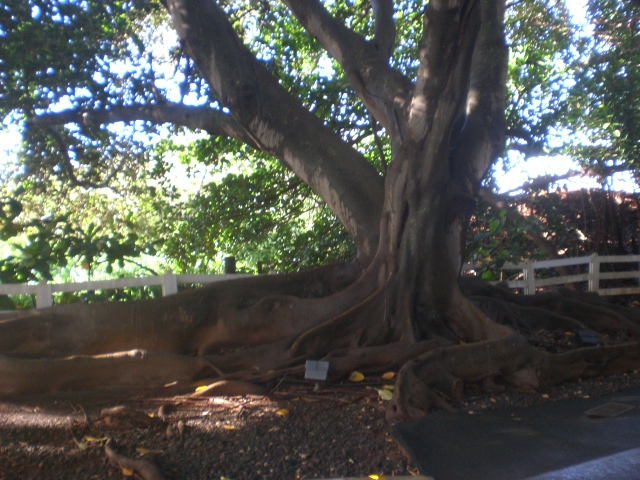
They’re sometimes called “trees on steroids,” the huge Moreton Bay Fig trees that grow seven times faster in Kauai than in their native Australia.  This tree, growing near the hotel where we stayed, is a youngster next to ones featured in the south-shore Allerton-McBryde botanical gardens. One, called the “Jurassic Tree,” was featured in the dinosaur movie “Jurassic Park,” whose filming began on Kauai in 1992. In the story’s plot, dinosaur eggs were found at its base, and from there ensued the high-drama conflict with wild mega-beasts. I never saw the film, but its theme song (which I heard in an Olympic figure skating competition about that time) was scary enough for me.

Tourists today can find the fictional “egg nest spot” amidst the Jurassic Tree’s huge buttressing roots, many as tall as a person.  These trees can grow to 200 feet high, have evergreen leaves, and impair growth of other trees around them.

Learning that reminded me of two similar passages about trees, one in Psalm 1 and the other in Jeremiah 17. Both tell of trees planted by a water source, unbothered by heat, reliably producing fruit. The analogy is to a believer, grounded in God’s Word, sustained by scripture, and producing spiritual fruit.  Then both swing to the negative:
“Not so the wicked! They are like chaff that the wind blows away.”  (Psalm 1:4)

“The heart is deceitful above all things and beyond cure. Who can understand it?” (Jeremiah 17:9)

Right now, two trees grow, as it were, in life’s garden. One is good, bountiful, beneficial, made up of Christians who believe they are called to serve their Lord through service to others.  Then there is an unruly tree that strangles anything around it. As Matthew Henry said long ago in his classic commentary:

The heart, the conscience of man, in his corrupt and fallen state, is deceitful above all things. It calls evil good, and good evil; and cries peace to those to whom it does not belong. Herein the heart is desperately wicked; it is deadly, it is desperate.

Calling “evil good, and good evil”—is nothing new? But it’s not a terminal condition. . Those who’ve lived apart from God can turn to Christ. So turning, Henry wrote, gives them “new desires, new pleasures, hopes, fears, sorrows, companions, and employments. [Their] thoughts, words, and actions are changed. [They] enter on a new state, and bear a new character.” 

Psalm 1 ends with the fate of those who reject God:  “perish.” I consider that destination more horrific than an imaginary monster story filmed in Kauai.

Friday, January 10, 2014

Making Psense of Psalms--Psalm 1: Choices


This blog begins a series on selected psalms that are important for believers to better understand. Next week: Psalm 8.

Psalm 1’s familiar phrase, “like a tree planted by streams of water,” comes to mind when I think about this painting hung above our fireplace. The artist was a great aunt who excelled as a painter and organist. She had a large theater organ with a full pedal board in her home—and how she could max its capabilities! More important, she was a godly woman who lived out her faith. Appropriately, the art I received as a gift depicts the first Psalm’s word picture of spiritual faithfulness. The healthy spiritual “tree”:

            *Draws life-giving water from the flowing stream, this analogy foreshadowing Jesus’ proclamation that He is the living water.

            *Yields fruit in season, as a Christian grows in the graces and “fruits” that reveal Christ working in his or her life.

            *Has no withering leaves.  Unlike normal trees, which yield to the seasonal patterns of growth, fruit, dying and dormancy, the Christian has continuous inner renewal.  D.L. Moody was fond of saying, “All the Lord’s trees are evergreen.”

            Beyond the memorable tree metaphor, Psalm 1 speaks plainly about spiritual choices. At first, this bothered me. I would have thought the opening “hymn” of the Jewish songbook would be exuberant praise. But instead of starting with people praising God, it begins with God blessing us. The first word, “blessed,” in Hebrew is actually plural.  Think of it as “truly blessed” or “blessed-blessed-and-blessed-again.”

            Then we’re given a thumbnail of this godly person’s character: avoiding the progressive moral decline of “walking,” “standing,” or “sitting” with sinners. He may befriend the ungodly in his circle of work and influence, but he doesn’t condone or join in their negative activities and attitudes. He is in the world, but he is not of it.

            Next, Psalm 1 tells us how he shores up his convictions: he diligently studies God’s Word. Jerry Bridges remarked in The Practice of Godliness (p. 93): “As we search the Scriptures, we must allow them to search us, to sit in judgment upon our character and conduct.  We must not treat the Scriptures only as a source of knowledge about God, but also as the expression of his will for our daily lives” (p. 93).

            In contrast, the ungodly are like chaff, the worthless straw the wind blows away when grain is threshed. At the end of time, at the eternal judgment that Rev. 20:11-15 calls the “Great White Throne,” they won’t have, as the phrase goes, a leg to stand on. Even if they did some moral good in their lives, this is not a matter of the “good” outweighing the “bad.” If they ignored or spurned Jesus’ offer of salvation, they will be shut out of Heaven.

            The psalm ends where Ephesians 2:8, 9 presents the rest of the story: we’re not saved by anything we do, but by faith in Christ. Then, we are saved to serve Him. As we do, “The Lord watches over the way of the righteous.”

            How should we respond to His blessing and watch-care? With praise, and more praise. And in that way, yes, Psalms begin with a call to praise.